When you’re creating a fantasy world (or just adding fantastical elements to the real world!), one of the things that can really break a reader’s suspension of disbelief is if your story lacks internal consistency.
To put it simply, every part in your world needs to make sense with all the other parts. It’s not so much that it has to be ‘realistic’ or explained in scientific detail, but that you need to consider how your world works when making decisions about what to put in it.
For example, let’s say I’m creating a completely original fantasy world where pigs are magical beings of extraordinary power who are considered tremendously sacred by the people of Country A. If I then have a scene in which characters in Country A eat a ton of bacon sandwiches, that’s probably going to make some gears grind together in a reader’s brain. It just doesn’t line up with the established workings of the world.
This can manifest in big and small ways, from defining how governments work to informing, I don’t know, what kind of shoes people wear. It’s not all about negative constraints, either – this isn’t just something you have to be careful about in case things don’t make sense. It can be a tool for taking one small part of your world and spinning it out into much wider and more detailed elements.
Let’s focus for now on that second aspect: looking at a single fantastical detail of your world and using it to explore new things. This is a great way not only to make sure that things do make sense, but to create compelling details that are both unique and consistent.
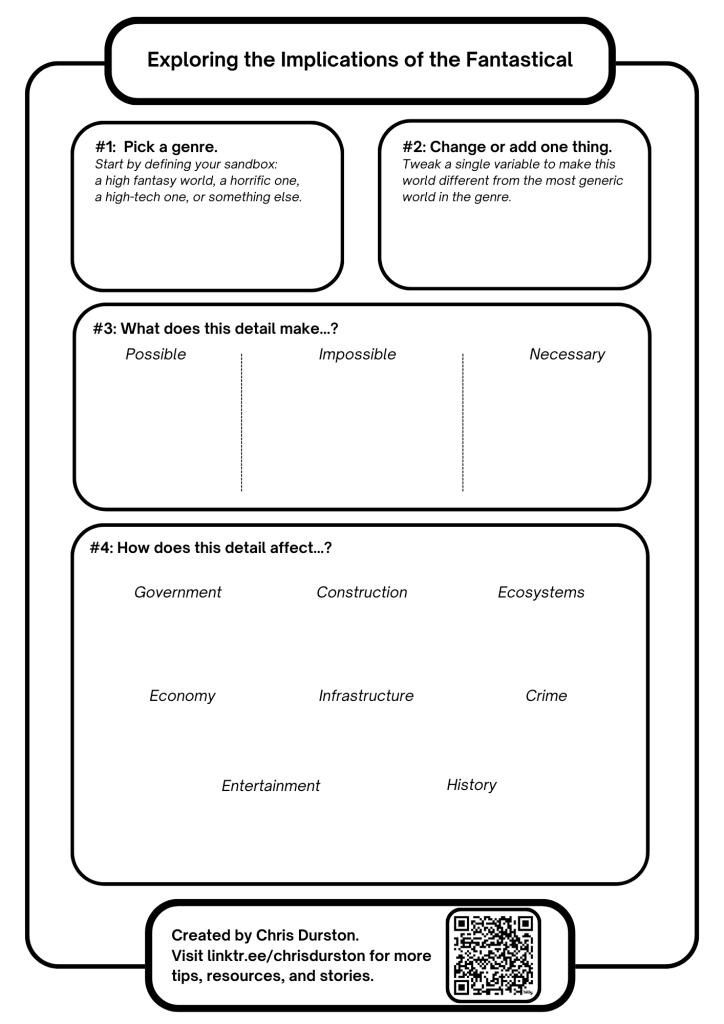
Step 1: Pick a genre.
For the sake of keeping the exercise simple, let’s start with a sort of template world, one very similar to a world you’ve read about in another book. Maybe you’re going high fantasy, so you’re starting with something similar to Middle-earth or Westeros. Perhaps you’re more an urban fantasy person, so your starting point is our real world.
Think of this as your foundation: a simple structure you’re familiar with.
Step 2: Change one thing.
OK, you’ve got a blank slate to start with. Now add one new element, one thing that differentiates this world from others. It should be a very top-level thing, something that affects lots of things about the world.
Maybe your starting point is a high fantasy world, and your point of difference is that some people can naturally detect truth and lies. Or maybe your starting point is a sci-fi world, and your new element is that there are beetles who are attracted to data streams and can eat data transmissions.
Step 3: What does this make possible, impossible, and necessary?
We’re thinking about three things here. Let’s take the data-eating beetles as an example.
If there are data-eating beetles in our sci-fi world, this means it’s possible that a lot of important information might be lost to their hungry little mandibles. Thinking a little further, this probably means it’s likely that one of two things has happened: either people aren’t relying on data transmissions and are adopting more analogue forms of communication, or they’ve worked out ways to mitigate the beetle problem (eliminating beetles, planning for data streams to only pass through known not-very-beetley areas, and so on). The beetles might only be a small part of the world – just one little way in which this world is different from others – but they open up a lot of possibilities. It’s also possible that the eating itself might have interesting effects on the beetles: maybe they grow as they consume more data until they explode, bursting in an icky wave of corrupted bits, or maybe they become more intelligent as they collect more information.
(The possible set of things is of course enormous. It’s possible that the presence of these beetles affects all kinds of food chains, spawns a black market in their shells, dictates fashion trends, provides new tools for espionage, and all sorts!)
They also close some things off, so what is now impossible? Well, it’s impossible for people to just transmit whatever data they like willy-nilly and assume it’ll always arrive uneaten, which again suggests that there’ll probably be a lot of people working very hard on a solution to this issue. This could cause all kinds of interesting problems if someone needs to get a message to someone else very quickly, but knows it probably won’t arrive in one piece: either they need to find a way around the issue, or accept that their transmission is going to be a bit garbled and potentially result in amusing or tragic misunderstandings. Or perhaps there are enormous nests of beetles that inevitably form wherever there are large servers, making it impossible to store huge amounts of data without creating a giant horde of little bug friends that present risks to maintaining the servers or travelling through that area. The inhabitants of this world need to find alternative routes where the beetles make it impossible to do things in the way they’d like.
And what’s necessary? Well, for there to be data-eating beetles, we have to imagine there’s data. So this sci-fi world… has computers. I mean, I think that’s obvious in a sci-fi world anyway, but still. Less obvious but more interesting might be something like a predator. These beetles must have some kind of natural threat, otherwise they would simply overwhelm the whole face of the earth. Of course, this could take a few forms: maybe the act of eating data is inherently dangerous (as in the exploding beetle example above), there’s some sort of bigger, worse, but rarer animal that eats them (a data-eating-beetle-eating bird that, once it’s eaten enough beetles, effectively becomes a living computer itself?), or humans have developed ways of controlling their population.
You can probably tell that possible, impossible, and necessary can easily yield the same or similar thoughts, but I still think it’s useful to think about all three so you ensure you don’t miss something interesting. The idea is to spin off from this new element to both widen and constrain things in your world, creating coherent settings that fit together logically.
A couple more examples might be useful here…
Possible: If people can fly, it’s possible that cities are built differently: there could be very high-up houses with no safety rails or ladders. (This might disadvantage those who can’t fly, of course.)
Impossible: If some people can create gold out of thin air, it’s impossible for there to be an economy that uses gold as a valuable commodity. (This means you need to think about what else could be valuable in this world – what’s rare and desirable?)
Necessary: If there’s a robot that runs around stealing people’s ice creams, it’s necessary that someone in this world must know how to manufacture robotics components (there must be mines for metal, tools for soldering, and so on) and that the technology or magic to keep food cold is widely available.
Step 4: How does this affect…?
Now we have some sense of what’s different about this world, we can start to apply it to all kinds of things. You can really take whatever part of your setting is important to your story and start there, but some suggestions for things on which you’ll want to consider the impact of this fantastical element include:
- Government or aristocracy: how does it affect law-makers, kings, emperors, courts, and those in power? Can they exploit it to control their populace? Do they fear it?
Our data-eating beetles require city governments to publicly show that they’re in control of the flow of information. In secret, they also use them to destroy information they don’t like… - Construction: how does it impact the way buildings, settlements, and other structures are built? Does it require buildings to protect against it? Does it open up new possibilities for how things could be created?
All buildings in our sci-fi city are built with a special material that deters the beetles, though of course it can’t prevent them from eating data sent out or coming in. There are huge cables built in winding routes and up in the air to keep data flows as far from beetle populations as possible. - Ecosystems: how does it affect the natural order: plants, animals, oceans, and landscapes? Does it disrupt natural chains and threaten wildlife? Does it allow new kinds of life to thrive?
The beetles have swarmed some areas that used to hold large servers. In some places, huge masses of them have died, leaving great shiny beetle-corpse mountains in their place. - Economy: is it valuable? Is it something everyone wants to spend money to keep away? Can it be used directly for trade, or indirectly to control the value of goods and services?
Everyone will pay good money for guaranteed secure transmission; lots of people sell ‘solutions’ that may or may not be proven to actually work. - Infrastructure: how does the day-to-day running of all the things in people’s lives change because of this? Does it create jobs just to manage it? Does it disrupt the post or make the supply of luxuries unpredictable? Perhaps most critically, does it affect the availability of necessities like food and water?
The beetles have necessitated a physical postal system that would otherwise seem antiquated. There are several public and private organisations devoted to managing them. - Entertainment: can people use it for their own amusement? Or do they need to find ways of amusing themselves to forget about how terrible it is?
Some people like to capture beetles and broadcast nonsense or inappropriate data at them to see what happens, a bit like giving drugs to a spider. - Crime: are there ways people can use this element to commit crime? Or does it give enforcers a tool to deploy, so criminals need to take extra care to avoid it?
Some people have worked out how to feed specific information to a beetle, then send it to a recipient as an illicit means of sending information. There are also government-trained beetles that seek out illegal transmissions. - History: how would the presence of this element have shaped key historical events?
The emergence of the beetles forced people to move away from old cities with their enormous server banks and computers everywhere. For a long time, a key political divider between the government and opposition was the question of whether to try to fight the beetles or just to accept them and live with them.
This step is all about going ‘so what?’ If you’ve got a magic system that allows people to do things they can’t in the real world, well, so what? What does that mean for this world and the people in it?
This can inform both settings and plot points – as you think of possibilities and limitations implied by the elements of your world, you can weave them into your narrative, hiding or revealing them at key moments to your readers’ delight.
Go have fun!
That’s… all I’ve got on this!
I’m sure this is the sort of thing that someone else must have articulated elsewhere and better, but I’ve never really seen it spelled out, so I thought I’d give it a go. Have a pop at this exercise – or way of thinking, really – and see if you can work through adding just one fantastical idea to a world and spinning it out into something that adds all kinds of richness to your world and story.
For more tips and resources, check out my page on, uh, tips and resources.
This exercise is downloadable as a PDF right here, or you can save the image below. Happy worldbuilding!
 Chris Durston