I think a big part of the joy of writing is inventing things that don’t really exist.
I mean, all fiction is that to an extent. Characters, events, objects, emotions – none of these things are real until we create them. But I think there’s something just straight-up fun about coming up with locations that don’t exist in reality: buildings, landmarks, structures, natural features.
Of course, even if you’re writing something set in a totally non-magical world, you’ll probably do a little bit of inventing of locations (unless you specifically decide to set every scene in an actual place you know). Here, though, I’m going to assume you’re writing something with at least a dash of non-reality, just because it gives us a lot more options. Whether that means you’ve got an urban fantasy, a horror story set in a world like ours but with a little extra darkness, or a full-on fantasy story set in a completely invented world, filling it with places and stuff is one of the delights of speculative writing.
I don’t know about you, but I find it can be a bit easy to fall into a pattern of inventing locations that feel… kind of archetypical, kind of done. You know, if you’re in a high fantasy world, you’ve got your classic castles and peasant towns and magical forests and whatnot. There’s a lot of rich material to draw on, and it can be really useful and fulfilling to do so, but sometimes you just want something a bit more unusual, something a reader will read and go ‘oh, wow, that’s cool’.
So here are five tips on creating less standard, more unique locations!
1: Play with scale
I think we inherently find things more interesting if we get a visceral sense that they’re bigger or smaller than they should be. A bear the size of a bear? No problem. But a bear the size of an ant? Weird! Or an ant the size of a bear? Also weird!
So one really simple way of making a location feel more interesting is to mess around a bit with its scale. A classic example from mythology is to have a tree that’s just impossibly huge, or another classic literary feature is the miniscule village of teeny-tiny houses.
You don’t just have to simply resize something, either – you can be more creative than just making it bigger or smaller. You know how when you click and drag the corner of a picture to just make it, like, the same picture but bigger? But if you click and drag the side, it makes it all distorted and disproportionate? Or you can rotate it, sometimes even kinda skew it?
Yeah, I’m not an artist or a visual designer, but hopefully you get what I mean. Point is, sure, you could take a lighthouse and make it a Really Big Lighthouse. But you could also make it a sideways lighthouse, or one that’s wider on the inside than it is on the outside, or one that kind of spirals around or leans at a 45-degree angle or is normal-sized but has a city-sized lightbulb on top, or one that curves like a flower stem, or… I don’t know, has another upside-down lighthouse on the bottom that goes down far further into the earth than the right-way-up one goes up towards the sky.
These might not be ‘scale’, exactly, but I kind of see it all as related. You take a thing and you mess around with its dimensions, its properties. You can make it disproportionate, make it look different when approached from different directions, all sorts.
2: Borrow from other genres
Let’s say you have a fantasy world with a cosy, kind of pastoral vibe. Your main characters spend most of their time in a small town filled with bakeries and bookshops, and their days are occupied with smelling sweet sugared candy and solving little mysteries like where the neighbour’s dog got that dashing pink bow tie it’s wearing.
One way you could make a location feel really memorable and interesting in this world would be to have it not fit into that setup whatsoever.
This is a bit risky, and you have to do it for a reason, but it can really work. Some of my favourite moments from stories are when there’s a sudden shift, derailing expectations and diverting somewhere else entirely. So in this world, perhaps we introduce a cave just outside the nice cosy happy town, and inside that cave are unspeakable horrors drenched with blood, bizarre rooms where the geometry doesn’t make sense, a colossal eye whose stare drives people to despair… you know, just the furthest possible thing from what this world has presented so far. We’ve dived into a completely different genre and shoved it into this place where it doesn’t belong.
Doing this is almost guaranteed to be memorable, but it can be for one of two reasons. If you make sure this unexpected shift feels earned, rewarding, and meaningful – in other words, if it contributes to telling the overall story – it can be a brilliant moment for readers to feel totally swept away. If it’s there for no reason, it’ll probably just feel jarring and weird.
Of course, there are less extreme examples. Maybe your sci-fi world has a couple of places that feel more magical or natural than the rest of the place, or perhaps your grimdark fantasy has one or two moments of respite in happier spots.
3: Create a historical event that changes the landscape
Your world has a history, and just like the real world, that history probably had an impact on local geography.
Let’s say your world’s creation myth features a war between a giant and a phoenix. The phoenix kills the giant, which falls over and dies somewhere. Now you have a whole bunch of things you could do with this knowledge: create geographical features from the giant’s body (real mythologies often do this exact thing to explain why islands are where they are!), have its bones form structures that people build on, create sprawling tunnels in the holes where its fingers pressed into the ground. Maybe there’s a great ravine where the giant’s body skidded before coming to a halt. You could have a city of tents stitched together from scraps of its clothes and hair, or offshore obelisks made of its teeth, or anything you like.
Those are pretty obvious big features you could develop, but you could also go a little more in-depth. Perhaps part of the story of the giant involves it wielding ice magic against the phoenix, which presumably means that ice magic is a thing in your world. You could therefore very naturally introduce some kind of icy structure formed during the battle, or from the remnants of magic thereafter. There might still be little sparks of power in there, or even pieces of the phoenix captured in the ice during the fight. It might feature big caverns where the phoenix’s wings beat the ice away, or smooth trenches where its talons scraped through.
Of course, there’s also more mundane stuff you can do here like have a big wall where a battle once took place, or a giant hole in a cliff where it was once struck by artillery. The point is, what happens in a place changes that place.
4: Lean into an obscure element of the world
I love when invented worlds really follow through on the implications of little details. Brandon Sanderson is, I think, particularly good at building his worlds and stories such that everything just kind of lines up: societies are structured as you would expect given the presence of specific kinds of magic or divinity, and the technicalities of magic systems almost always come into play. (Some of the conclusions of his stories make very satisfying use of obscure, apparently useless, or edge-case features of his magic systems, which I always really like.)
Anyway, we can do that to come up with awesome and unusual locations that feel completely consistent with the world around them.
Say you’ve established that there’s gravity magic in your world. Perhaps it doesn’t feature hugely in the story, but it’s there. That means you now have the ability to create a location that would only be possible with the use of gravity magic.
I’m talking floating cities, yeah, but I’m also talking labyrinths that go up and down and sideways and gravity never stays consistent; I’m talking columns of water that rise endlessly up out of the ocean; I’m talking cathedrals where the gravity is stronger in certain points, forcing people to kneel or bow. This is all completely doable given the presence of gravity magic, and in fact it sort of feels inevitable that these would all exist – someone would have done these things! (Or perhaps the magic just kind of did some of these things itself. Who knows?)
So wherever you have fantastical elements, use those to work out what would happen as a result of them existing.
5: Make something completely inexplicable
It’s nice to have things that are consistent and explicable within the rules and frameworks of your world, but it can also be fun to occasionally have something that just doesn’t make sense. Maybe you can come up with an explanation for how it got there, but I always think it’s totally plausible for there to be things in invented worlds that none of the characters understand, things of which nobody’s ever been able to work out the cause or mechanics.
For this, playing around with physics is often a good go-to. Locations that warp time and space are always fun, after all. Or something made of a completely alien material that defies all attempts to alter or understand it, or perhaps a place where nothing ever behaves consistently at all. Maybe it’s alive, or maybe it might be alive, or maybe it’s a one-to-one replica of the bodies of the people who are inside it… you can get bizarre, is the point.
It can be difficult to do this kind of thing without it feeling… just sort of too much, or random, or out of nowhere, but sometimes you want a location that inspires confusion and awe even in characters who are used to seeing magical and impossible things. When you need something that just makes everyone – your readers outside the story, and your characters inside it – go ‘what?’, simply pulling out something that has no real rhyme or reason, no understandable place in the universe, can be kind of a stylish way to do it.
Mix and match!
Of course, you can use more than one of the tips above to create a single place. I like locations that are Very Weird, so finding ways to make them stand out as unusual within the world always feels fun to me.
It probably goes without saying, but not every location can be weird, or it loses its effect. A lot of your world probably will be populated with, y’know, your classic cities and deserts and oceans and stuff, but dropping one or two utterly strange and unique settings in there can really help the whole thing pop.
For more writing tips, visit my tips and resources page.
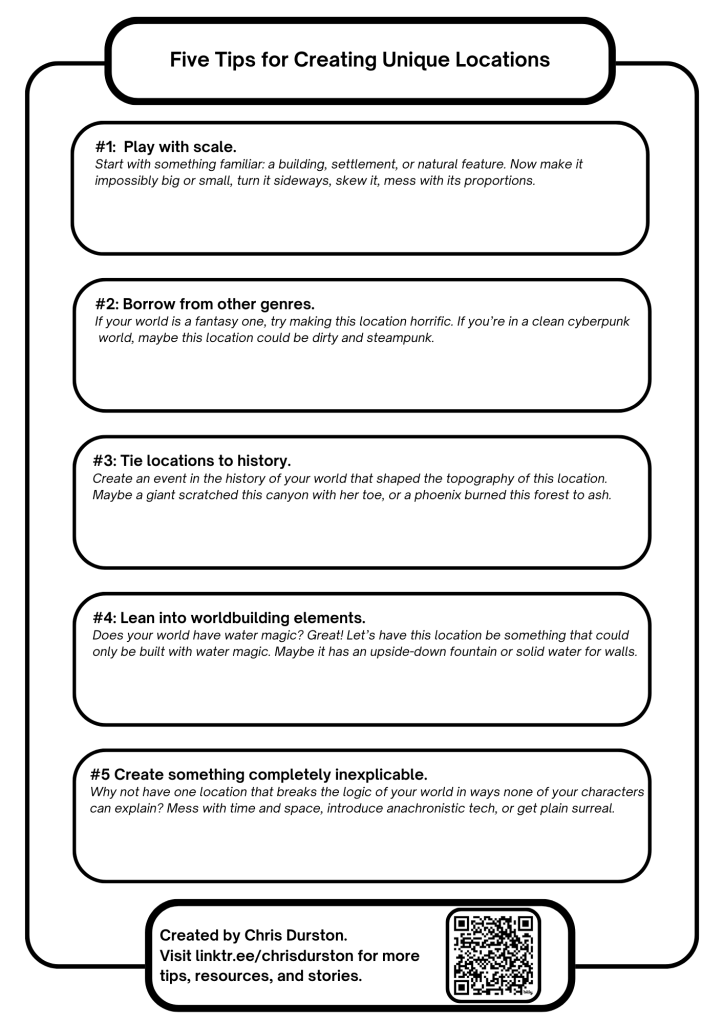
You can also download the tips on this page as a simple worksheet (like I said, I’m not a designer!). It’s here in PDF format, or you can save the image below.
 Chris Durston